

 Indonesia
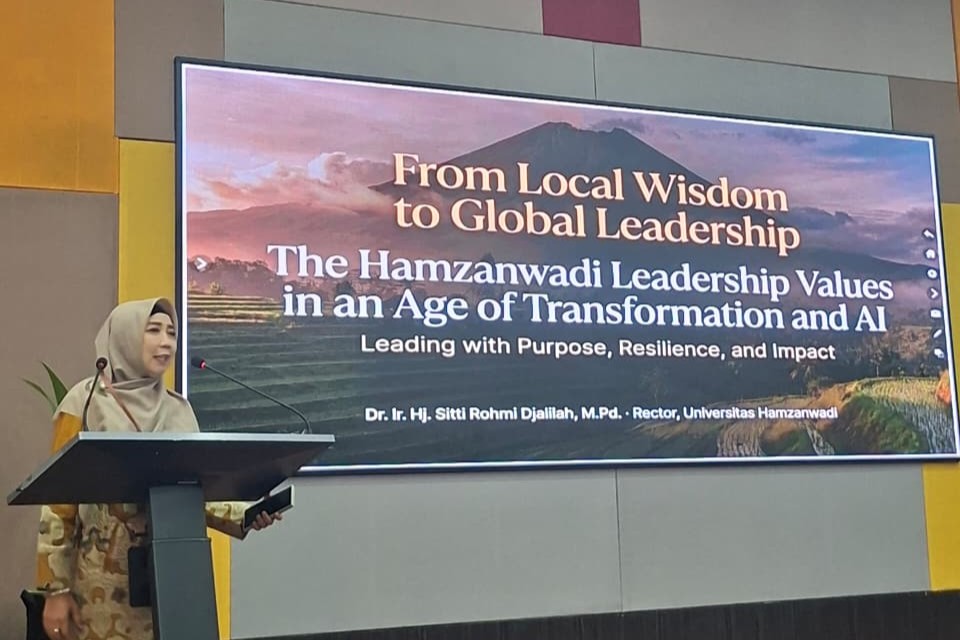
In a General Study at UPM Malaysia, the Chancellor Discussed the Relevance of Kiai Hamzanwadi's Leadership in Facing the AI Era.
Malaysia – Future leadership will not simply rely on technological sophistication, but must be built on purpose, resilience, integrity, and the ability to create sustainable social impact for the wider community.
This idea was conveyed by the Rector of Hamzanwadi University, Dr. Ir. Hj. Sitti Rohmi Djalilah, while speaking at Universiti Putra Malaysia (UPM) on Monday, July 13, 2026, through a paper entitled "From Local Wisdom to Global Leadership: The Hamzanwadi Leadership Values in an Age of Transformation and AI – Leading with Purpose, Resilience, and Impact."
Ummi Rohmi began her presentation by discussing the concept of the "Lombok Paradox," a situation where a region rich in natural resources, strong Sasak culture, and strategic geographic location still faces challenges of poverty, limited access to education, and low social mobility.
According to her, these issues are not solely related to geography, but rather to the ability to build community agency, aspirations, and leadership.
"Transformation doesn't start with infrastructure or technology, but with people. Before transforming institutions, we must transform people's aspirations and beliefs about what they can achieve," said the rector, often known as Umi Rohmi.
She emphasized that education is the most strategic instrument for strengthening social mobility while building the collective capacity of society, thereby creating sustainable change across generations and eras.
On the occasion, Rohmi also reviewed Kiai Hamzanwadi's leadership journey as a leading educational reformer in Lombok. She explained that the establishment of Nahdlatul Wathan Diniyah Islamiyah (NWDI) in 1937 was a significant milestone in the birth of modern Islamic education in Lombok, combining Islamic values with the demands of the times.
The rector explained that Kiai Hamzanwadi not only founded an educational institution, but also built community confidence, fostered aspirations, and created a collective agency that drove social change. This spirit continued through the establishment of STKIP Hamzanwadi in 1977, which evolved into Hamzanwadi University in 2016.
Furthermore, the Rector explained the five core values that underpin the Hamzanwadi leadership system: Confidence, Sincerity, Patience, Gratitude, and Istiqomah. These five values are not understood as standalone stages, but rather as a mutually reinforcing unity in building transformative leadership.
According to him, strategy only determines the direction of travel, while values determine how a leader persists when facing challenges that continually arise at every step toward achieving a goal.
The value of Confidence is seen as aligned with visionary leadership, Sincerity reflects servant leadership, Patience is related to resilient leadership and adaptive capacity, Gratitude represents positive leadership that values every process, and Istiqomah reflects sustainable leadership through consistency and discipline.
"Intellectual traditions may use different terminology, but the fundamental principles of leadership actually converge," he explained.
He also highlighted the challenges of leadership in the era of artificial intelligence. According to him, the higher the level of automation and the greater the abundance of data, the greater the need for human qualities that cannot be replaced by machines.
"AI can help humans make decisions, but it cannot replace integrity, empathy, wisdom, and values-based leadership. The future requires leaders who can combine technology with character, competence with compassion, and innovation with humanity," he concluded.
The leadership values inherited from national hero TGKH Muhammad Zainuddin Abdul Madjid, also known as Kiai Hamzanwadi, are considered to remain relevant and even more necessary to face the era of digital transformation and artificial intelligence (AI).
It is hoped that this general studium will provide a space for the exchange of ideas on how leadership values borne from local wisdom can contribute to the development of global leadership amidst the acceleration of digital transformation and the development of AI.